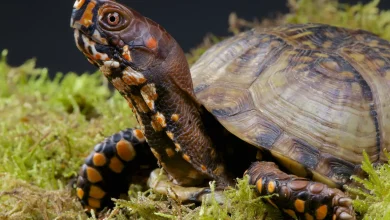
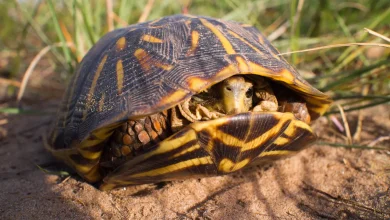
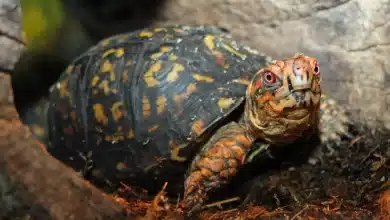
If you feed your box turtle pellets and lettuce, you are slowly making it sick. Box turtles are opportunistic omnivores with one of the most varied wild diets of any North American reptile, and the captive diet that keeps them healthy looks a lot more like a forest floor than anything you will find in a pet‑shop bag. This is the diet we feed our own animals, broken down by species, by life stage, and by food group, with the things to avoid in red and the things to include weekly in green.
By Maya, with calcium and supplementation reviewed by Ben.
Table of Contents
What box turtles actually eat in the wild
If you spent a week following a wild Eastern box turtle (Terrapene carolina carolina) and recorded every meal, the rough breakdown would be:
- Invertebrates — slugs, snails, earthworms, beetles, caterpillars, isopods, millipedes, spiders, occasional small crustaceans near water: ~45–55%
- Fungi — surprisingly high in the wild diet; box turtles can safely eat mushrooms that would kill a human: ~10–15%
- Fruit and mast — fallen berries, wild grapes, fruits of dogwood/persimmon/serviceberry, acorns, nuts: ~15–25%
- Greens, flowers, and fungi — dandelion, plantain, clover, violet leaves, wild strawberry, mushrooms again: ~10–15%
- Vertebrate prey — opportunistic. Carrion, the occasional hatchling bird or frog, baby mice: under 5%
The two big takeaways: invertebrates are the single largest food group, and the plant fraction is dominated by fruit and mast, not lettuce. Most captive diets get both wrong — too many pellets, not enough live prey, far too much salad.
The captive diet target
Working back from the wild diet, here is the captive diet ratio we use for healthy adult North American Terrapene:
- 40–50% animal protein (live where possible, frozen‑thawed where not)
- 20–30% fruit, berries, mast
- 20–30% vegetables, greens, flowers
- 5–10% fungi
Adjust those ratios by species: Ornate box turtles tip more toward invertebrate prey (perhaps 55%), Florida box turtles tip toward fruit and fungi (perhaps 30%). Hatchlings tip heavily toward animal protein for their first 6–12 months (60–70%). Older animals (15+ years) tip slightly back toward plant matter as activity drops.
Frequency
- Hatchlings (0–12 months): daily, small portions, dusted with calcium 3× a week and multivitamin 1× a week.
- Juveniles (1–4 years): 5–6 days a week, calcium 2× a week, multivitamin 1× a week.
- Adults (4+ years): 3–4 days a week, calcium 2× a week, multivitamin every 7–10 days.
- Pre‑hibernation (autumn): taper feeding over 2–3 weeks, fast in the final 2 weeks. See our hibernation guide.
- Hibernation: no food.
- Post‑hibernation (spring): start with light invertebrate offerings, build back up over 2 weeks.
Portion size: enough food that the turtle finishes most of it in 15–20 minutes. Box turtles will not “self‑regulate” if you over‑feed them daily — they will become obese. Mild hunger between feeding days is normal and healthy.
Animal protein — what we feed
Excellent (offer often)
- Earthworms — gold standard. Calcium‑rich, well‑accepted, ethically sustainable to breed at home. Buy from a bait shop only if you trust the supplier (no pesticide exposure).
- Slugs and snails — exceptional calcium content, easy to wild‑catch from pesticide‑free gardens.
- Isopods (woodlice) — high in calcium, can be cultured in the enclosure substrate as a self‑sustaining clean‑up crew.
- Black soldier fly larvae (Phoenix worms) — high calcium, modest fat.
Good (rotate in regularly)
- Crickets — feeder grade, gut‑loaded for at least 24 hours before feeding.
- Dubia roaches — better protein and lower fat than crickets, very accepted.
- Mealworms — limit to once a week; high chitin, harder to digest.
- Silkworms — excellent protein and calcium, hard to source.
- Hornworms — high moisture, occasional treat.
Occasional
- Pinky mice — frozen‑thawed, no more than once a month, suitable for larger adults only.
- Cooked unseasoned lean meat — small amounts, monthly maximum.
- Hard‑boiled egg — once a month, mashed.
Avoid
- Wild‑caught insects from any pesticide‑treated area. Neonicotinoids and organophosphates kill box turtles. We have lost a hatchling to this — it was not quick.
- Lightning bugs / fireflies — toxic to many reptiles.
- Wild‑caught vertebrate prey of unknown health status.
- Cat or dog food as a staple — too rich, wrong calcium ratio. Occasional pinch as enrichment only.
Fruit and mast — what we feed
Excellent
- Strawberries (whole, hulls on)
- Blackberries, raspberries, blueberries
- Mulberries (if your turtle is outdoors under a mulberry tree, congratulations)
- Figs
- Wild grapes — yes, including skins
- Cantaloupe, watermelon (small portions, high water)
- Pear, apple (no seeds — apple seeds contain trace cyanogenic compounds)
Good
- Banana (small portions — turtles love it; high sugar)
- Peach, plum, nectarine (no pit)
- Cherry (no pit; same cyanogenic compound issue as apple seeds)
- Persimmon, when ripe
Occasional / treats
- Mango (sugar)
- Pineapple (acidic; small portions only)
- Tomato (acidic; ripe only; not green parts of the plant — toxic)
Avoid
- Citrus fruits (lemon, lime, orange) — acidity disrupts gut pH
- Avocado — contains persin, dangerous to most reptiles
- Rhubarb (any part) — oxalic acid
- Any fruit that came from a fruit bowl with mould on the next item over
Greens and vegetables — what we feed
Excellent
- Dandelion (leaves and flowers — both safe, both accepted)
- Plantain (the weed, not the banana relative)
- Violet leaves and flowers
- Clover
- Mustard, collard, turnip greens
- Endive, escarole, radicchio
- Romaine — only as a small fraction (more on this in a moment)
- Hibiscus flowers and young leaves
- Rose petals (unsprayed)
Good
- Bell pepper (red and yellow)
- Squash and pumpkin (cooked or raw, small chunks)
- Sweet potato (small amounts, raw or cooked)
- Carrot (small amounts)
- Cactus pad (nopal) — needs spines removed
Avoid
- Iceberg lettuce — essentially water, almost no nutritional value, fills the turtle without nourishing it
- Spinach as a staple — oxalates bind calcium; small occasional amounts are fine
- Cabbage and broccoli as staples — goitrogenic in large amounts
- Raw onion and garlic — disruptive to red blood cells
- Potato (especially green portions) — solanine
- Rhubarb (leaves and stalk) — oxalic acid
The romaine note: it is not actively bad, but it is mostly water and very low in calcium. We use a leaf or two as a vehicle for chopped vegetables and fruit, not as the bulk of a salad.
Fungi — what we feed
Box turtles eat surprising volumes of mushroom in the wild, including species that would put a human in hospital. The detoxification chemistry of Terrapene handles a wider range of fungal compounds than ours. That does not mean you should feed your turtle wild mushrooms. The species composition of safe vs toxic mushrooms varies by region, and the only people who reliably tell them apart are mycologists.
What we feed: cultivated grocery‑store mushrooms (button, cremini, portobello, oyster, shiitake) — all safe, all well‑accepted, all a great way to add variety. Once a week is plenty.
What we do not feed: anything we collected from the woods unless we are absolutely sure of the species and it is on a known‑safe list. The cost of a mistake is too high.
Calcium and supplementation
This is where most diet problems show up. Box turtles need a calcium‑to‑phosphorus ratio in their diet of roughly 2:1 or higher. Most invertebrate prey is significantly lower than that — earthworms are around 1:1.5 against the box turtle’s needs. Without supplementation, every meal slowly drains calcium from the skeleton and shell, causing metabolic bone disease (MBD), soft shell, and eventually death.
The fix is simple and cheap:
- Calcium powder without D3 — dust feeder insects and salads 2–3 times a week for adults, more for hatchlings.
- Calcium with D3 — only if your turtle is not getting adequate UVB exposure (indoor‑only, dated bulb, etc). For outdoor turtles or those under a current T5 HO 6% UVB, use plain calcium and let the turtle make its own D3.
- Multivitamin — once a week, dusted lightly. Vitamin A is the one to watch — deficiency causes the swollen‑eyelid presentation Ben sees in clinic.
- Cuttlebone — drop a piece in the enclosure. Some turtles will rasp it directly; others ignore it but will accept ground cuttlebone dusted on food.
Brand: Repashy Calcium Plus, Zoo Med Repti Calcium, Arcadia Earth Pro — all fine. Avoid generic “calcium sand” or anything labelled for substrate use.
The pellet question
Should you ever feed commercial box turtle pellets? Our answer: occasionally, as a fraction of variety, not as a staple. The better brands (Mazuri tortoise diet, Zoo Med Natural Box Turtle Food) are nutritionally adequate, but they do not replace the variety, hydration, and behavioural enrichment of a fresh diet. We feed pellets perhaps once every two weeks as a top‑up, never as a meal in their own right. The keepers we know whose turtles run on pellets exclusively have animals that are usually overweight, often dehydrated, and rarely as alert as they should be.
Water and hydration
Box turtles drink, soak, and absorb water through the cloaca. They need a shallow water dish at all times, changed daily. Many keepers soak their turtles 2–3 times a week — we soak ours daily during the hottest months and weekly the rest of the year, more often for hatchlings. A 15‑minute soak in lukewarm water also encourages defecation, which is convenient when you are spot‑cleaning.
Reading the turtle
You can usually tell whether the diet is working by looking at the animal:
- Shell smooth and evenly coloured — good calcium, good UVB.
- Pyramiding (peaks on scutes) — too much protein, often too little humidity, sometimes too little exercise.
- Soft shell — calcium/D3 deficiency. Vet visit.
- Swollen eyelids or ear bulges — vitamin A deficiency, possible aural abscess. Vet visit.
- Visible weight loss — many causes. Weekly weighing catches this early.
- Refusing food for more than a week outside of brumation prep — investigate temperature, humidity, lighting, and call a vet if husbandry is correct.

Further reading on Box Turtles
- Box Turtle Care — the umbrella husbandry guide
- Box Turtle Enclosure Setup — the housing cornerstone
- UVB & Lighting for Box Turtles
- Box Turtle Health Problems & Vet Care
External references
- UC Davis Veterinary Medicine — exotic species nutrition
- Association of Zoos and Aquariums — captive husbandry guidelines
If you are unsure whether a specific food is safe for a specific subspecies, Maya keeps the diet notes — write in via the contact page.