North American Box Turtles
Species and Subspecies of North American Box Turtles

All about the North American box turtles. Below you will find a list about all of the known species in the genus Terrapene. Look at the list below or at the top menu to find more detailed information on each species.
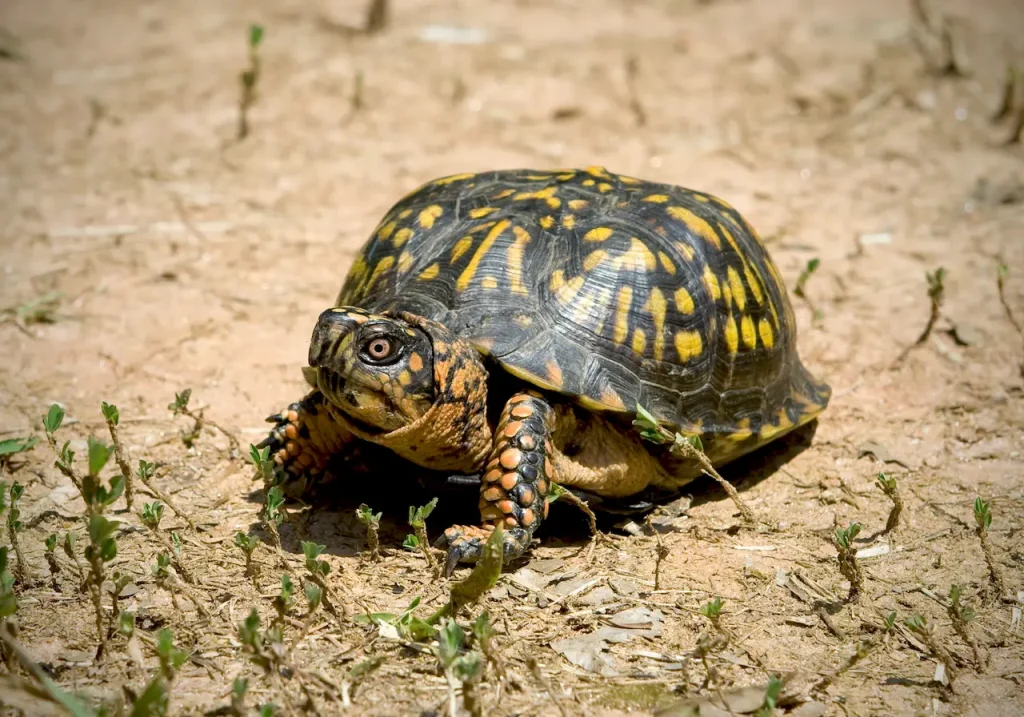
Common Box Turtle (Terrapene Carolina, Linnaeus, 1758)- The most prominent and well known type of box turtle, of which most of the North American subspecies hail. Its official status is “vulnerable.”
Table of Contents
Common Box Turtle Subspecies:
- Eastern Box Turtle (Terrapene carolina carolina, Linnaeus 1768)
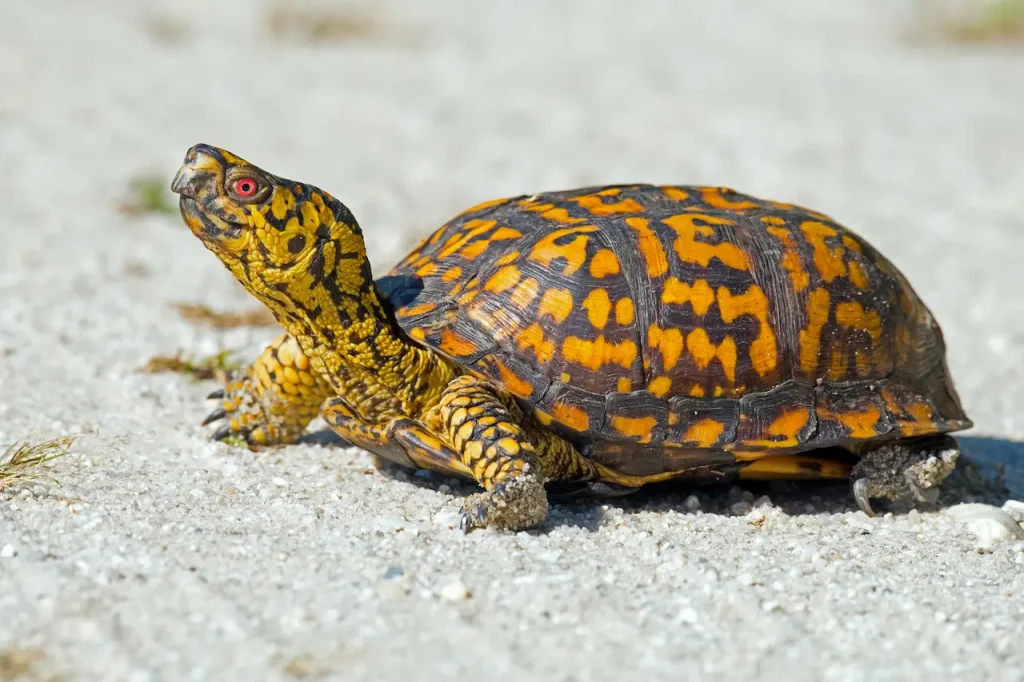
This subspecies gets its common name due to being located in the eastern United States. It is one of the more well-known subspecies and its official status is vulnerable. - Florida Box Turtle (Terrapene carolina bauri, Taylor 1895)
This subspecies gets its name due to being found almost exclusively in the state of Florida, although it occasionally can be found in southern Georgia. Its official status is “least concern”. - Gulf Coast Box Turtle (Terrapene carolina major, Agassiz 1857)
This subspecies can be found along the Gulf of Mexico, ranging between the American states of Louisiana and Florida. - Three Toed Box Turtle (Terrapene carolina triunguis, Agassiz 1857)
It gets its common name from its iconic three toes on its hind legs. They are more enduring of new surroundings than most box turtles, and is thus to be regarded as one of the better subspecies to keep as pets. - Mexican Box Turtle (Terrapene carolina Mexicana, Grey 1849)
This subspecies is endemic to Mexico. There are export laws against in place to protect them, and they are rarely seen in the pet trade. - Yucatan Box Turtle (Terrapene carolina yucatana, Boulenger 1895)
This subspecies is endemic to the Mexican state of Yucatan. While it does not have an official endangered rating (outside of connection to the main species, Common box turtle; which would place it at vulnerable) locals have reported seeing less and less of them in recent years.
Coahuilan / Aquatic Box Turtle (Terrapene Coahuila, Schmidt and Owens 1944) – The only known Aquatic box turtle in North America; thus its common name. They are endemic to Coahuila, Mexico. Their official status is endangered.
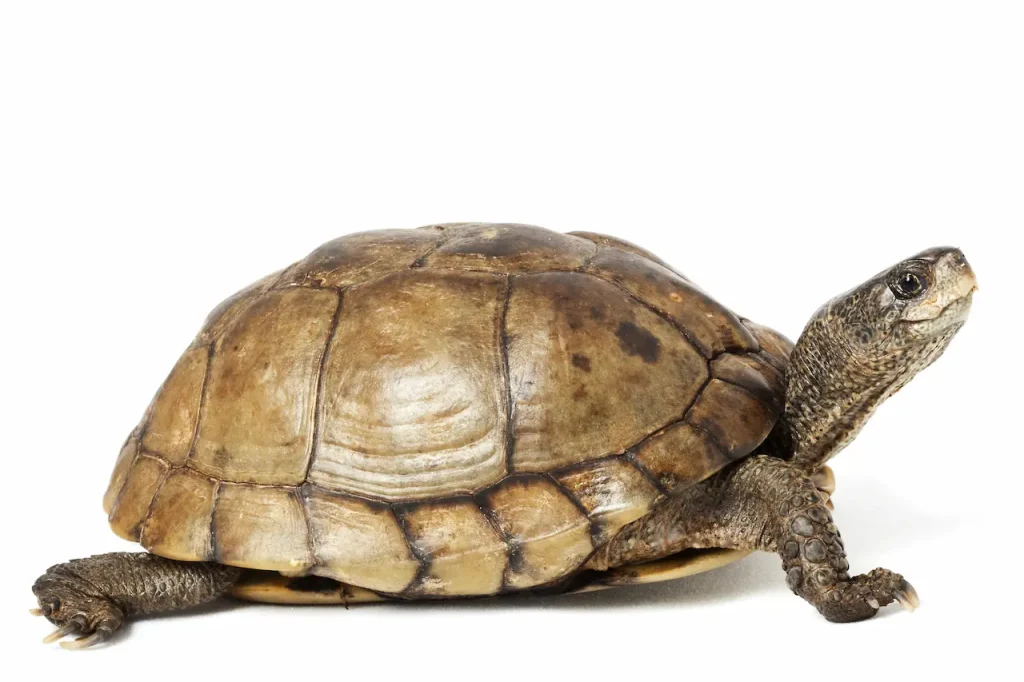
Spotted Box Turtle (Terrapene Nelsoni, Stejneger 1925) – This species has not been studied very thoroughly. It has two known subspecies, the Northern and Southern spotted box turtle, on which very little information is available. The species gets its name for the tiny spots all over its shell. It has no official status in terms of endangerment, due to lack of study.
Search for the Northern Spotted Box Turtle. Watch the video here.
Spotted Box Turtle Subspecies:
- Northern Spotted Box Turtle (Terrapene nelsoni klauberi, Bogert 1943)
- Southern Spotted Box Turtle (Terrapene nelsoni nelsoni, Stejneger 1925)
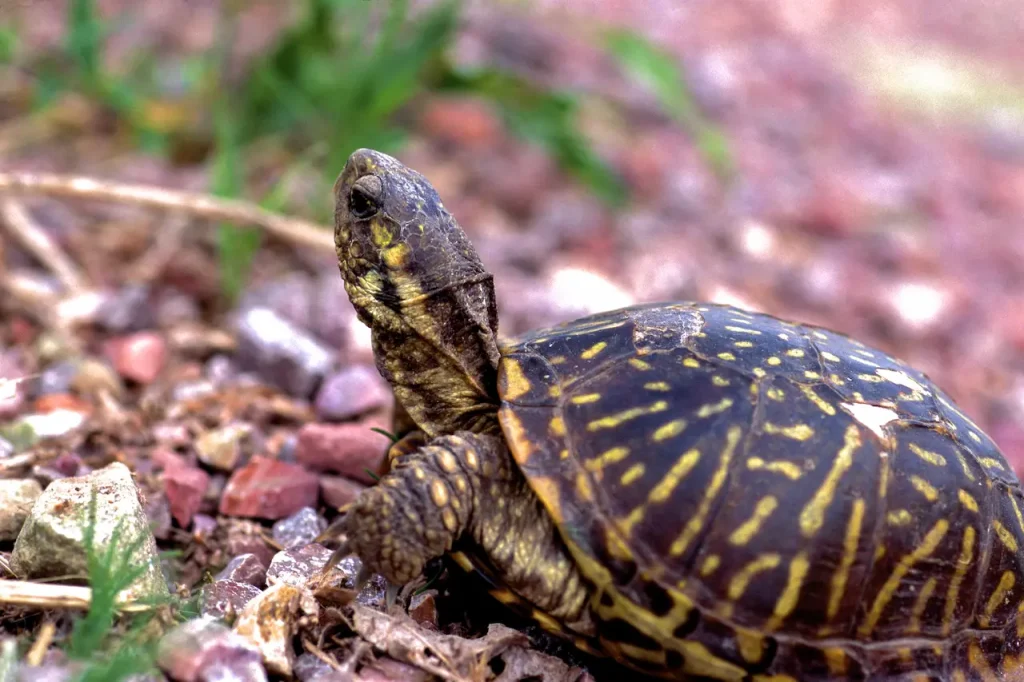
Western Box Turtle (Terrapene ornate, Agassiz 1857) – This species has less of a dome shape in its shell, causing it to look a bit flatter in appearance than other box turtles. It has two subspecies, the Desert box turtle, and the ornate box turtle.
The Western Box Turtle, also known as the Ornate Box Turtle, lives in prairies and grasslands in the Midwestern United States. These turtles are 4-5 inches long and have a dark brown, dome-shaped shell with bright yellow lines.
Western Box Turtles eat both plants and animals. They enjoy insects, vegetables, greens, and fruits. In the spring, they mate and females lay 1-2 groups of eggs each year, with each group having 1-8 eggs.
The eggs take about 70 days to hatch, and the baby turtles are about 3 cm long. These turtles grow up and become adults at 7-8 years old. However, they face threats from human activities like farming, building cities, and being taken as pets.
Western Box Turtle Subspecies
- Ornate Box Turtle (Terrapene ornata ornate, Agassiz 1857)
A subspecies of the Western box turtle. Its official status is near threatened. - Desert Box Turtle (Terrapene ornata luteola, H.M Smith and Ramsey 1952)
It gets its common name from being found in several of the dryer states, such as Texas, New Mexico, and Arizona.
Summary Of The North American Box Turtles
Box turtles, once common in backyards across the United States and Mexico, are now struggling to survive. In his book North American Box Turtles, C. Kenneth Dodd, Jr. provides a detailed look at the twelve species and subspecies of this endangered animal. The book covers their evolution, behavior, mating, habitat, diet, population, classification, and diseases.
Special features of the book include:
- Color photos of all species, subspecies, and their habitats
- A simple identification guide for living and fossil species
- A summary of fossil Terrapene and how Native peoples used box turtles
Each chapter ends with sections on future research needs, such as long-term monitoring and conservation efforts. The book also includes a glossary and a bibliography.
All royalties from the book sales will go to the Chelonian Research Foundation, a nonprofit organization dedicated to turtle conservation.

The four species and their subspecies (current taxonomy)
Under the 2013 Martin et al. revision and subsequent follow-up work, the North American box turtles break out like this:
Terrapene carolina — Common box turtle
- T. c. carolina — Eastern box turtle
- T. c. bauri — Florida box turtle
- T. c. major — Gulf Coast box turtle
Terrapene mexicana — formerly part of T. carolina
- T. m. mexicana — Mexican box turtle
- T. m. yucatana — Yucatán box turtle
- T. m. triunguis — Three-Toed box turtle
Terrapene ornata — Ornate box turtle
The 2013 revision collapsed the previously recognised desert subspecies T. o. luteola into T. ornata. See our Ornate box turtle species page.
Terrapene nelsoni — Spotted box turtle
- T. n. nelsoni
- T. n. klauberi
Terrapene coahuila — Coahuilan box turtle
The aquatic Terrapene, restricted to the Cuatro Ciénegas basin in Mexico. Critically endangered.
What all North American box turtles share
Despite the spread of habitats — humid southeastern pine flats for Florida bauri, short-grass prairie for Ornate, coastal marsh for Gulf Coast — there are characteristics every Terrapene shares:
- Hinged plastron. A single hinge across the plastron that allows the animal to fully close its shell. The hinge is the diagnostic feature of the box turtles within Emydidae.
- Small home range. Most adults occupy 1–3 hectares of habitat for their entire adult life.
- Strong site fidelity. A box turtle moved more than a few hundred metres will try to return for the rest of its life, often unsuccessfully.
- Omnivorous diet. Invertebrates, fruit, fungi, vegetation, occasional vertebrate prey. The proportions vary by species but the breadth doesn’t.
- Long lifespan. 40+ years is normal, 80+ years documented in the wild for some populations.
- Late sexual maturity. 7–10 years for most species. This is the demographic feature that makes wild populations slow to recover from any pressure.
- Temperature-dependent sex determination. Warmer nests produce more females.
- Vulnerable conservation status. Most Terrapene species are listed at or above IUCN Vulnerable. See our conservation page for the current picture.
How to tell the species apart
Quick field identification for the most-encountered North American Terrapene:
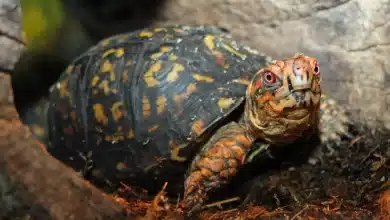
- Eastern (T. c. carolina): dark carapace with yellow/orange irregular markings; usually four toes on hind feet; tall domed shell; widespread across eastern US.
- Florida (T. c. bauri): three toes on hind feet; bright radiating yellow lines on each scute; helmet-shaped shell; restricted to Florida and the Keys.
- Three-Toed / Mexican (T. m. triunguis): three toes on hind feet; muted brown carapace without strong markings; males often have brilliant orange head colouration; central US to Mexico.
- Gulf Coast (T. c. major): the largest Terrapene, often 15+ cm carapace; muted plain carapace; coastal Gulf of Mexico habitats.
- Ornate (T. ornata): dark carapace with bright yellow rays on each scute; flatter shell than Eastern; short-grass prairie habitat.
- Spotted (T. nelsoni): small, with scattered yellow spots on a darker base; northwestern Mexico.
What they need from a keeper
If you keep any North American box turtle, the core requirements are the same across the genus, with species-specific tweaks on humidity and brumation:
- Box Turtle Enclosure Setup — what an actual working enclosure looks like
- UVB & Lighting — the tube, the placement, the replacement schedule
- Box Turtle Diet — what to feed and what to avoid
- Box Turtle Health Problems — the conditions to watch for
- Box Turtle Hibernation — when to do it, when to skip
Asian box turtles are a different story
The “box turtle” name is used for two only-distantly-related genera: Terrapene in North America (covered on this page), and Cuora in Asia. They share the hinged-plastron defensive structure through convergent evolution, but the husbandry needs are very different — most Cuora are semi-aquatic and need setups closer to aquatic turtle setups. See our Asian box turtle page for the other genus.
Where to read next
- Box Turtle Care — the umbrella husbandry guide
- The 2013 Terrapene revision — current taxonomy in detail
- Box Turtle Conservation — wild populations and what good keepers can do
- Terrapene carolina putnami — the extinct Pleistocene giant that hints at the genus’s deeper history