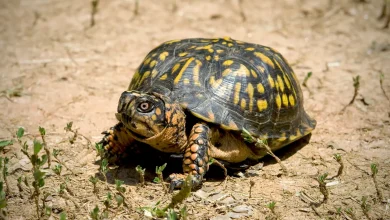
The Gulf Coast Box Turtle is a subspecies of common box turtle.
- Terrapene Carolina major (Agassiz, 1857).
Table of Contents
Gulf Coast Box Turtle Distribution
As the name would imply, the gulf coast box turtle can be found along the Gulf of Mexico. They cover a wide region and can be found from Florida to Louisiana. On occasion they can even be found as far east as eastern Texas.
Gulf Coast Box Turtle Habitat
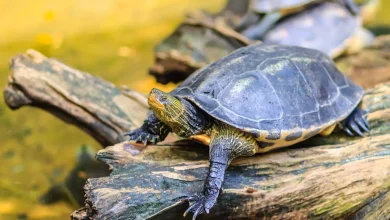
This subspecies of box turtle loves to be around water. The gulf coast box turtle will typically be found in marshes and swamps; which there are many of along the northern regions of the Gulf of Mexico. They like shallow waters that maintain a consistent water level throughout the year.
While they are not aquatic and do not live in water, they like to travel to shallow waters often. Being so close to water also offers them a nice, consistent humidity.
The semi-tropical nature of some of these areas, such as the swamps of Florida; offer reliable warmth for most of the year. If things become too cold, they will hibernate.
Body
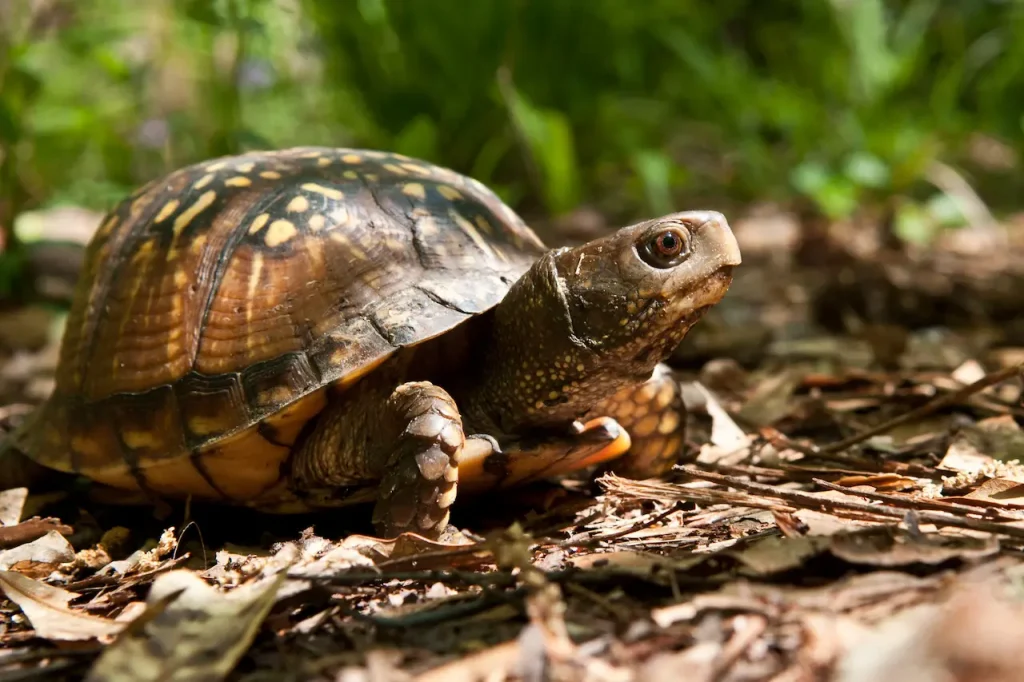
Of all the sub-species of box turtle, the gulf coast box turtle is the largest. They have a large dome shell. Their skin and shell is often dark colored, such as browns and blacks.
Sexing a Gulf Coast Box Turtle
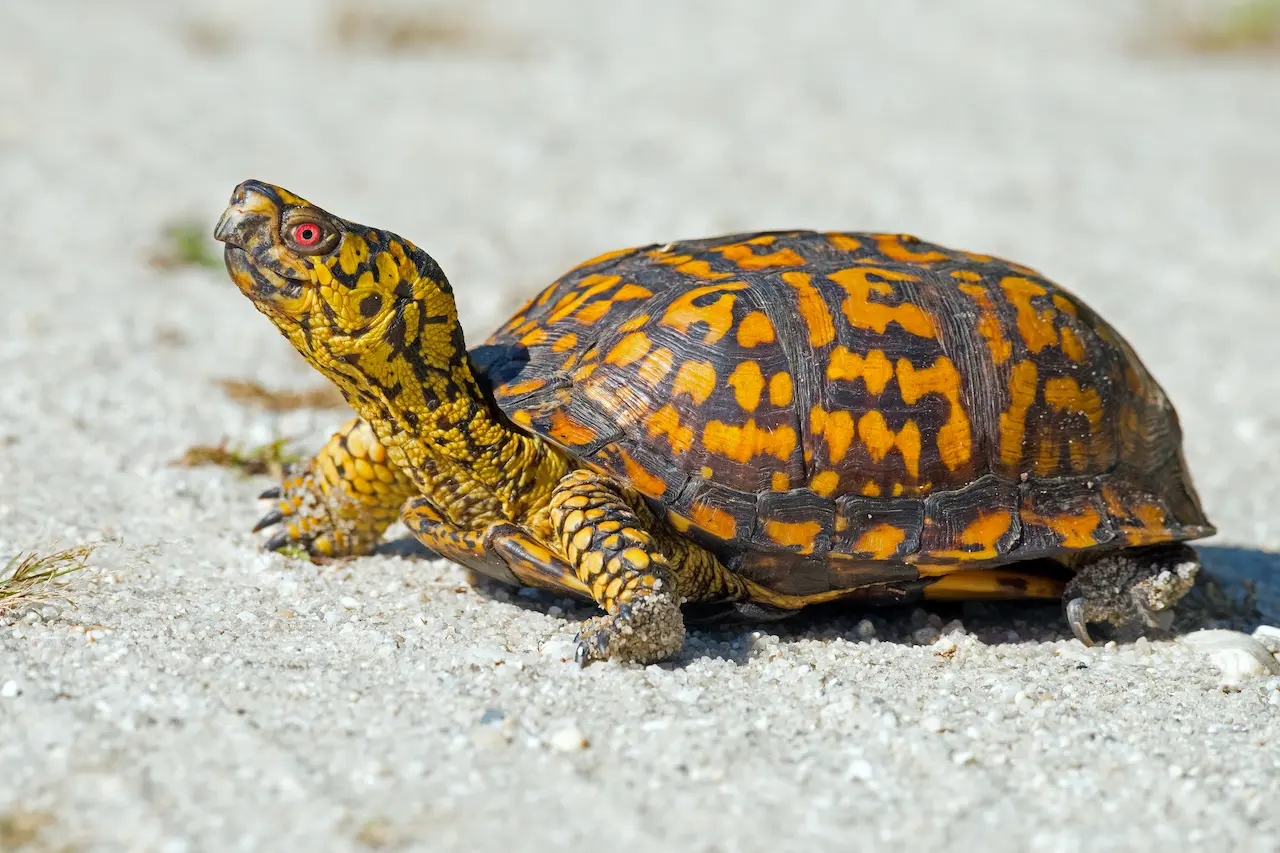
There are a few ways you can determine the gender of a gulf coast box turtle. The male’s eyes will sometimes have a red iris while the females do not; this is one of the easier ways to sex the turtle.
The other means of sexing may require having two specimens to compare side by side. Males typically have larger tails, both in length and girth; but this offer little insight without a basis of comparison. You can also look at the plastron, the lower portion of the shell. Males will sometimes have a concave curve to their plastron; this shape is to help them mount a female turtle during mating. Females tend to have flat plastrons.
What does Gulf Coast Box Turtle Eat?
As with many turtles, the gulf coast box turtle is an omnivore. This means it eats both meat and plant matter, and must have both in its diet to stay healthy.
Gulf coast box turtles get their meat primarily from live insects that they hunt. This is one of the reasons they always live near shallow water, as this is a massive breeding ground for many insects. They will hunt snails, worms, beetles, grasshoppers, slugs, grubs, and virtually any insect they can find and capture.
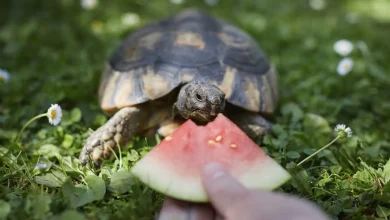
The rest of their diet consists of plant matter and fungi, such as moss, grass, berries, fruit, and mushrooms.
How Old can a Gulf Coast Box Turtle Get?
Like most box turtles, the gulf box turtle has the potential to live for a long time, and have been recorded to reach a hundred years of age in the wild. When in captivity for most of their lives, this number is believed to diminish in most cases.
Keeping Gulf Coast Box Turtles as Pets
Gulf Box Turtles need careful care when being kept as pets. In some cities, laws are being passed to protect wild gulf box turtles from capture. It is often recommended to buy a gulf box turtle that was bred in captivity, both to avoid legal issues and because already mature turtles that are taken from the wild can sometimes die of stress.
Housing a Gulf Coast Box Turtle
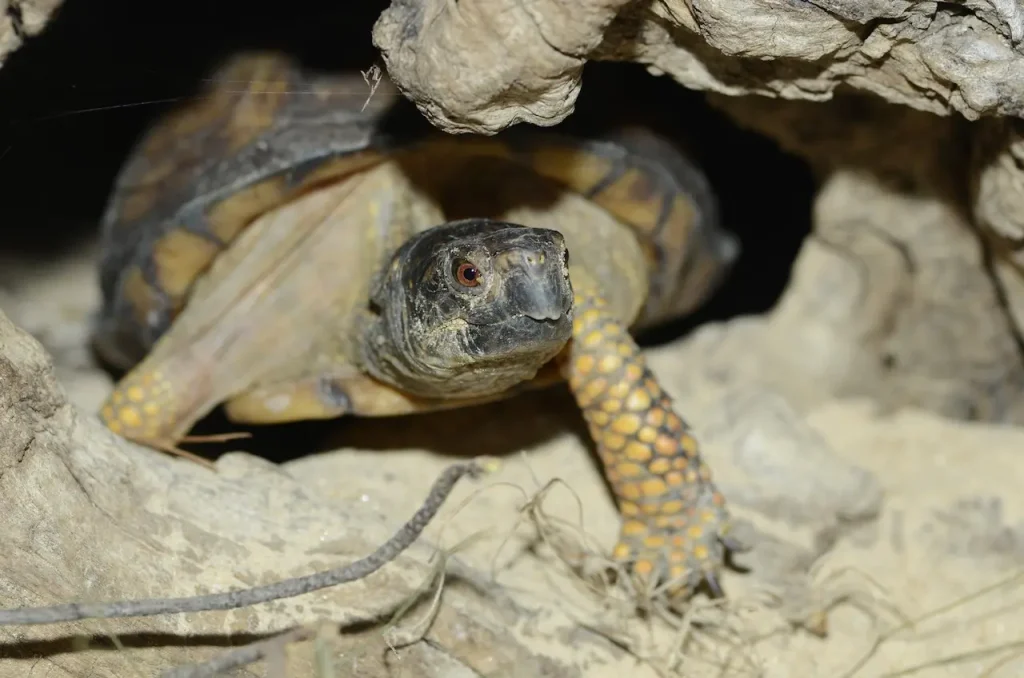
The first thing a potential owner will have to look into is acquiring an enclosure for them to live in. Some people keep their pet turtles indoors, especially during their early years of life. But the Gulf Box Turtle often fairs better when kept in an outdoor enclosure, during their adult years.
This enclosure must mimic their native environment as best as possible, but it indoor or outdoor. A pet gulf coast box turtle has the best chance of survival if it is being kept within its native region. For instance, an outdoor enclosure in Florida is always going to be far better suited for the turtle than an outdoor enclosure in Maine.
Since they are cold blooded, your enclosure needs to have an ultraviolet heating lamp. This should be positioned not in the middle of the enclosure, but to one side of it. This way the turtle has the option to move closer or further away from the heat source as needed.
Your enclosure will also need a large water dish of some fashion. It needs to be big enough that the turtle can get inside it and soak if they like. The water must be changed often; it has to stay clean.
When putting down matting, it needs to be made of a loose material that your turtle can burrow into. They need this as well as an area they can use for shade.
The enclosure should be tall enough and sturdy enough that the turtle cannot escape from it.
Feeding a Gulf Coast Box Turtle
As mentioned earlier, gulf box turtles are omnivores. You must have both meat and plant matter in their
diets to keep them healthy.
Most turtles are hesitant to eat dead bugs and will prefer to hunt live ones. You can buy feeder insects such as crickets and grubs at most pet stores. They will eat almost any small bug.
For plant matter, focus on things that often grow in swamps and marsh lands, such as mushrooms, moss, and grass. They can also eat berries and fruit.
Monitor what your turtle is eating and make sure he is getting a good balance of meat and plant matter.
Parasites
Parasites can be a hassle for turtle owners, because tiny parasites can get under scales and shells where they cannot be seen or dealt with. If your gulf box turtle came from the wild, it is important you take them to the vet and make sure they do not have any parasites. If you keep your turtle in an outdoor enclosure, it can be a good idea to take them in
References
- Iverson, J. B. 1992. A Revised Checklist with Distribution Maps of the Turtles of the World
- Fritz, Uwe; Peter Havaš (2007). “Checklist of Chelonians of the World”. Vertebrate Zoology 57 (2): 198–199.
Current taxonomy
The Gulf Coast box turtle is Terrapene carolina major under the current taxonomy — a subspecies of the common box turtle, alongside T. c. carolina (Eastern) and T. c. bauri (Florida). The 2013 Martin et al. paper left the unresolved question of major‘s exact status open; subsequent work (notably Martin et al. 2020) confirmed enough genetic distinctness to retain its subspecies status, though it remains an active research area. See our revision summary.
Identification — the biggest Terrapene
Gulf Coast box turtles are unmistakable once you have seen one. Adults are typically 15 cm or larger in carapace length, sometimes pushing 18 cm — significantly bigger than any other living Terrapene. The bulk shows in shell height and limb thickness as well as carapace length.
Other identification cues:
- Muted carapace pattern — often nearly plain, with subtle radiating markings that fade with age
- Bulky head and neck
- Four toes on each hind foot
- Stronger swimmer than Eastern or Three-Toed
- Range restricted to coastal Gulf of Mexico habitats — eastern Texas, Louisiana, Mississippi, Alabama, the western Florida panhandle
Habitat — the swamp specialist
Gulf Coast box turtles live in the wettest habitat of any North American Terrapene. Coastal swamps, bayou edges, brackish-to-fresh transitions, lowland pine flats with high water tables. They swim better than other subspecies, regularly cross small water bodies, and use water for thermoregulation more often than their drier cousins.
The species is exposed to a particular set of habitat pressures: coastal development, salt-water intrusion from sea-level rise, hurricane mortality, and agricultural conversion of lowland habitats. Their range is small, their habitat preferences are narrow, and the long-term trajectory is concerning.
Captive husbandry
Scale up the standard Terrapene setup:
- Footprint: increase floor area by 30–50% over Eastern keeping. Adults need more room.
- Water: deeper than for other subspecies — knee-deep on the turtle when standing rather than ankle-deep. They will use it. Supervise hatchlings around standing water; even competent swimmers can drown if exhausted.
- Humidity: 70–80%, with a wet end. They tolerate damp better than they tolerate dry.
- Temperature: basking 32–35°C, ambient 24–27°C indoors. Outdoor keeping works well in the species’s native range.
- Diet: standard Terrapene ratio with extra aquatic invertebrates and a higher fraction of animal protein for the larger body mass. See our diet cornerstone.
- Brumation: light cycling rather than full brumation in most cases. Wild populations in southern Louisiana and Florida panhandle do not deeply brumate; mimic that.
Where to read next
- North American box turtles
- Box Turtle Care
- Box Turtle Enclosure Setup — including the Gulf Coast variant
- Box Turtle Diet
- Box Turtle Conservation — coastal Gulf habitat pressures are a particular concern for this subspecies