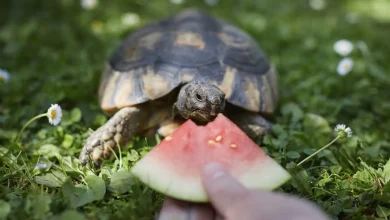
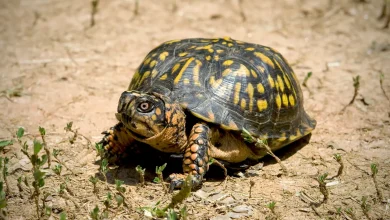
Terrapene ornata is a species of box turtle commonly known as the Western Box Turtle.
Table of Contents
There are two different subspecies of Terrapene ornata:
- Ornate box turtle, Terrapene ornata ornata (Agassiz, 1857)
- Desert box turtle, Terrapene ornata luteola (Smith & Ramsey, 1952)
Distribution
U.S. states where wild western box turtles live: Arizona, Arkansas, Colorado, Illinois, Indiana, Iowa, Kansas, Louisiana, Missouri, Nebraska, New Mexico, Oklahoma, South Dakota, Texas, Wisconsin, Wyoming
Mexican states where wild western box turtles live: Chihuahua, Sonora
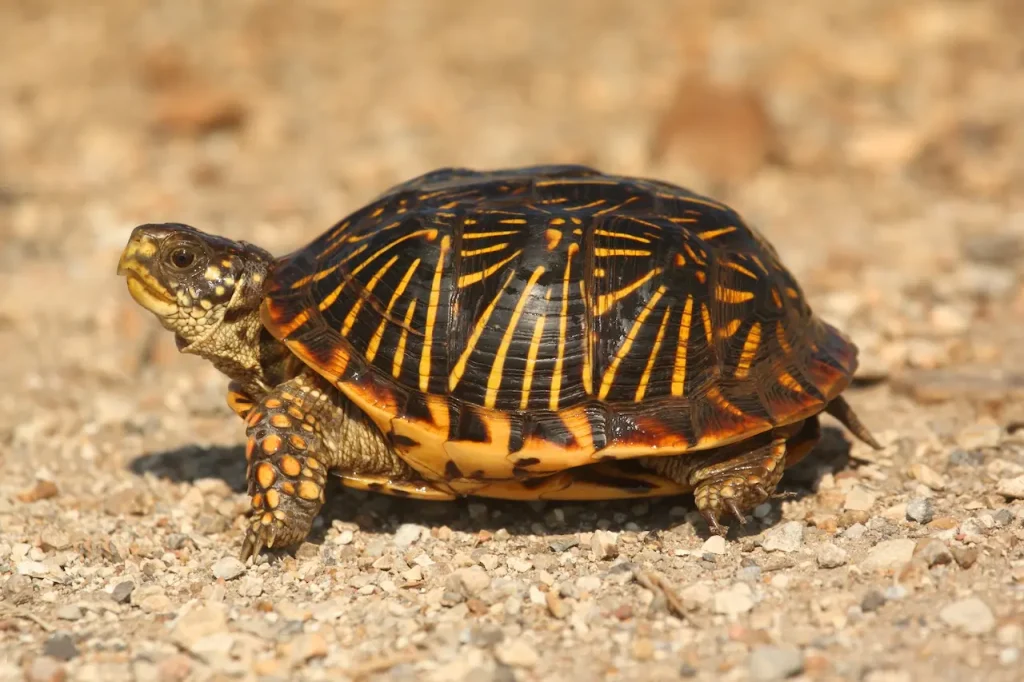
Western box turtles are found in the central and western United States and the adjoining areas of northern Mexico. You can find them from the Rocky Mountains to the Mississippi, in the Sonora Desert and northwards up to South Dakota and Wisconsin.
The ornate box turtle (Terrapene ornata ornata) is found throughout most of the species range and inhabits a region that stretches from Wisconsin and western Indiana to Louisiana and eastern Texas. The northernmost specimens live in the southern part of Wisconsin.
As the name suggests, the desert box turtle (Terrapene ornata luteola) is adapted to arid conditions. It is found in dry areas of western Texas, New Mexico, south eastern Arizona and northern Mexico. In Mexico, its range includes the northern parts of Sonora and most of Chihuahua
Western Box Turtle Habitat
Western box turtles live on prairies and in deserts, depending on subspecies. It usually spends it whole life in a small area (less than few acres). In the fall, the western box turtle will dig a shallow hole to hibernate in during the winter.
The ornate box turtle (Terrapene ornata ornata) is chiefly a prairie creature. It can enter forests, especially along streams, but it is chiefly found on treeless sandy plains and grasslands with scattered low bush vegetation.
The desert box turtle (Terrapene ornata luteola) is adapted to more arid conditions and is found on the desert fringe. Of all the box turtles in the world (not just Terrapene ornata), the desert box turtle is the one that inhabits the driest areas.
Body
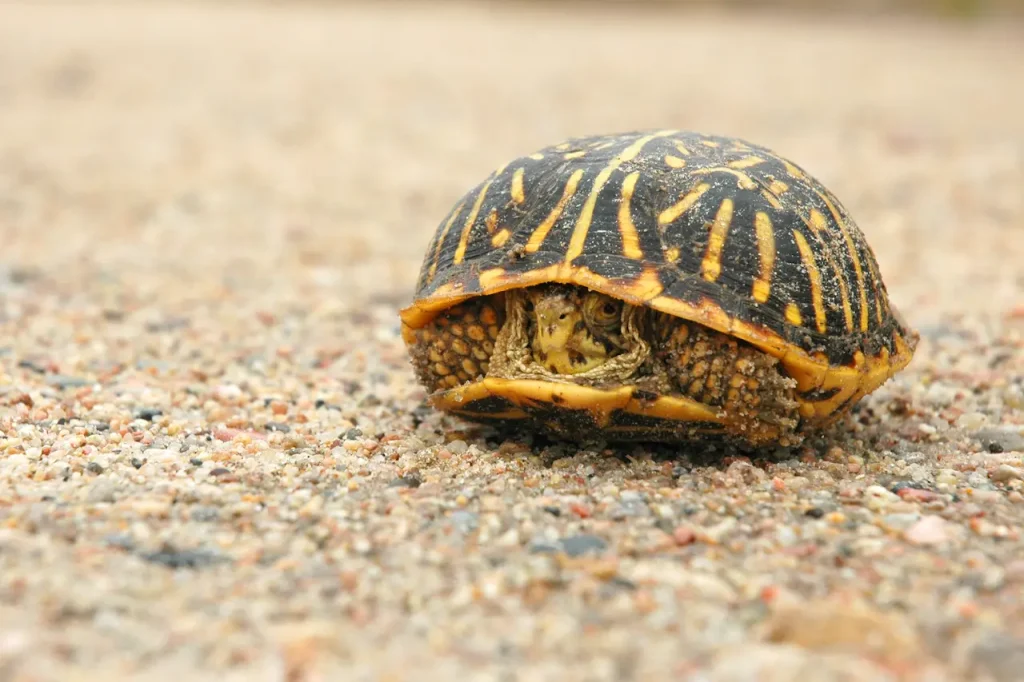
The carapace of the western box turtle is less domed than that of other box turtle species and it looks a bit flattened. For both sexes, the length of the carapace can exceed 15 centimetres. The colouration of the carapace is usually black or dark brown with yellow striping. The desert box turtle tends to display more striping than the ornate box turtle.
Most male western box turtles reach sexual maturity when their plastron is 10-11 cm long. For females, the number is 11-13 cm. Males are usually 8-9 years old at this point, while females normally do not reach sexual maturity until they are 10-11 years of age.
What does an Western Box Turtle eat?
In the wild, the western box turtle chiefly lives on insects, spiders, worms, carrion and berries. It is known to catch beetles, grasshoppers and caterpillars.
How old can an Western Box Turtle get?
The maximum age of western box turtles in the wild remains unknown. One of the oldest known captive specimens was a female that exceeded 40 years of age.
Keeping Western Box Turtles as pets
For information about keeping western box turtles as pets, please see specific recommendations for the Ornate Box Turtle and the Desert Box Turtle since they live in very different habitats in the wild and therefore have very dissimilar requirements.
Please note that catching, buying or keeping a wild-caught western box turtle (or a captive-raised western box turtle without the proper documentation) may be illegal in your area.
References
- Yancey, Franklin R., II. 1997. Geographic Distribution. Terrapene ornata ornata. Herpetological Review 28 (2): 95
- Vinke, T. & Vinke, S. 2004. Keeping and breeding the Ornate Box Turtle, Terrapene ornata ornata. Reptilia (GB) (32): 25-30.
- Stebbins, R. 1985. A Field Guide to Western Reptiles and Amphibians. Houghton Mifflin Company. Estados Unidos.
- Rabb, George B. 1961. Natural history of the ornate box turtle, Terrapene ornata ornata Agassiz. Copeia 1961 (1): 123-124
- Philippen, H.-D. 2004. Box turtles of the genus Terrapene. Reptilia (GB) (32): 12-18
- Legler, John M. 1960. Natural history of the ornate box turtle, Terrapene ornata ornata Agassiz. University of Kansas Publications, Museum of Natural History 11 (10): 527-669
- Iverson, J. B. 1992. A Revised Checklist with Distribution Maps of the Turtles of the World
- IUCN Red List http://www.iucnredlist.org
What “Western box turtle” actually refers to
The name “Western box turtle” has historically been used for the Ornate box turtle, Terrapene ornata, and sometimes informally for any of the more western Terrapene. Under the current taxonomy (post-2013 Martin et al.), the formal species is just Terrapene ornata — the older subspecies split into T. o. ornata (the central plains animal) and T. o. luteola (the southwestern desert animal) collapsed into a single species when the genetic data showed no meaningful divergence between them.
So if you have a “Western box turtle” or a “Desert box turtle” in your care, taxonomically it is now Terrapene ornata, regardless of whether it came from Kansas, New Mexico, or Sonora. The husbandry distinction between the central-plains animals and the desert-population animals is still real and useful — those populations live in different climates, and an animal from one environment needs slightly different care from an animal from the other.
Range and habitat
The Western (Ornate) box turtle occurs from southern South Dakota and Nebraska south through the central US and into northern Mexico, with the southwestern desert populations extending across Arizona, New Mexico, southwestern Texas, and parts of northern Sonora and Chihuahua.
Habitat: short-grass and mixed-grass prairie, sandy soils, open grasslands with scattered shrubs, semi-arid scrub. This is a more open environment than the eastern box turtle’s preferred woodland and woodland-edge, and the species’s morphology reflects that — flatter shell, longer legs proportionally, stronger digging adaptations.
Identification
Recognise a Western (Ornate) box turtle by:
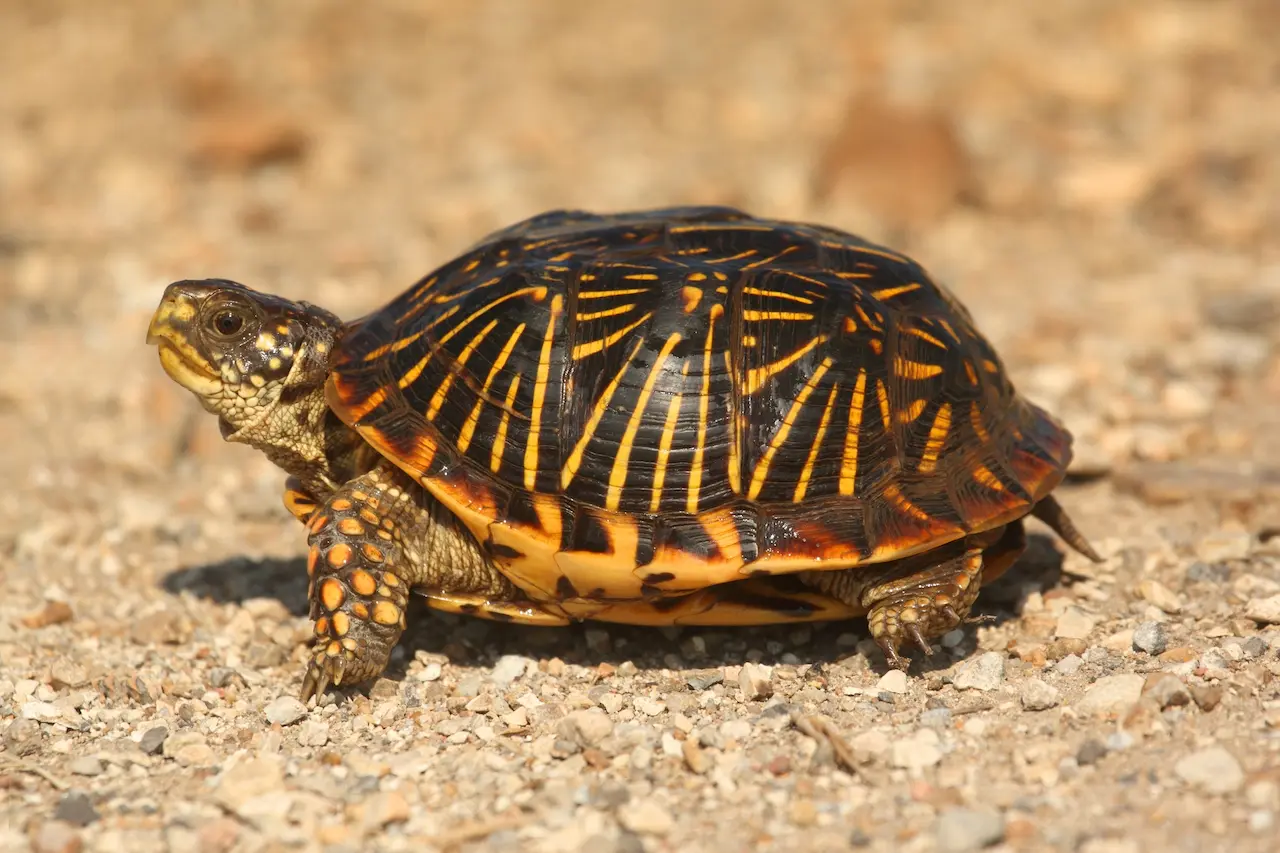
- Distinct radiating yellow lines on each carapace scute, against a dark base — the “ornate” pattern that gives the species its name.
- Flatter, more dome-rounded carapace than the tall helmet shape of Eastern or Florida box turtles.
- Plastron also patterned — usually showing yellow lines on a dark base, similar to the carapace.
- Smaller average size than Eastern box turtles — adults usually 10–13 cm carapace length.
- Four toes on each hind foot (Florida box turtles have three; Three-Toed/Mexican have three).
- Males often have green eyes rather than the red eyes of male Eastern box turtles. Females usually have brown.
Husbandry — the prairie species
Western box turtles need a setup biased toward the prairie/semi-arid end of the Terrapene spectrum:
- Humidity: 50–65% ambient, with a damp hide available. Significantly drier than Eastern, Florida, or Gulf Coast keeping. Over-humid enclosures stress the species and contribute to shell and skin problems.
- Substrate: sandy-loam blend — topsoil mixed with playground sand and leaf litter. Not pure sand (too dry, dusty), not pure topsoil (too dense, too moist).
- Lighting: stronger UVB than the woodland species. Arcadia ProT5 12% (Desert) or Zoo Med ReptiSun 10.0 is appropriate; target UVI 4.0–6.0 at the basking spot. See our UVB cornerstone.
- Temperatures: basking 32–35°C surface; hot end ambient 27–30°C; cool end 22–25°C. Night drop more pronounced than for Eastern keeping — down to 18°C is fine.
- Diet: tipped slightly toward animal protein (~55%). Wild Ornate box turtles eat a substantial volume of beetles, grasshoppers, and other prairie invertebrates. See our diet cornerstone for the full ratio.
- Outdoor keeping: works very well in temperate continental climates with cold winters and warm dry summers. Ornate box turtles are arguably the most outdoor-tolerant Terrapene for keepers across the central US.
Brumation
Western box turtles brumate hard in the wild. Adult animals in good condition can be cycled successfully through indoor controlled brumation at 4–7°C for 10–14 weeks. See our hibernation cornerstone for the full protocol. Skip the cycle for hatchlings (first winter), underweight animals, and any animal recovering from illness.
Conservation
The Ornate box turtle is listed as Near Threatened on the IUCN Red List, with population declines driven by prairie habitat loss, agricultural conversion, road mortality, and illegal collection. Several US states list Terrapene ornata as a species of conservation concern; collection is restricted across most of its range. As with all Terrapene, never buy wild-caught animals — captive-bred only.
Where to read next
- Ornate box turtle — the main species page
- North American box turtles — the genus overview
- Box Turtle Care — the umbrella husbandry guide
- Box Turtle Conservation — wild population pressures and ethical sourcing
- Box Turtle Enclosure Setup — including the prairie/ornate setup variant