The common box turtle has six sub-species still in existence, these are;
- Eastern Box Turtle, Terrapene carolina carolina, (Linnaeus, 1758)
- Florida Box Turtle, Terrapene bauri (Taylor, 1895)
- Gulf Coast Box Turtle, Terrapene carolina major (Agassiz, 1857)
- Three Toed Box Turtle, Terrapene carolina triunguis (Agassiz, 1857)
- Mexican Box Turtle, Terrapene carolina Mexicana (Grey, 1849)
- Yucatan Box Turtle, Terrapene carolina yucatana (Boulenger, 1895)
There is also an extinct sub-species of common box turtle, known as the Terrapene carolina putnami, with no common name.
The Eastern Box Turtle variant is the type species of the common box turtle.
Table of Contents
Common Box Turtle Distribution
This turtle is found primarily in the eastern regions of the United States.
They prefer lightly moist regions in forested areas. They can be found as high north as Maine and as far south as Texas if the conditions are right.
Common Box Turtle Habitat
Common Box Turtles can be found in dry regions occasionally, but they tend to thrive best in moist, forested areas with lots of brush. They are not aquatic, but will sometimes spend long durations of time in shallow water or mud.
Body
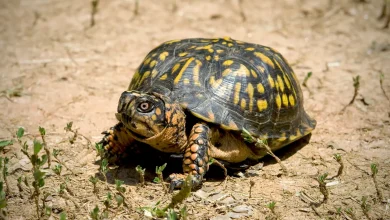
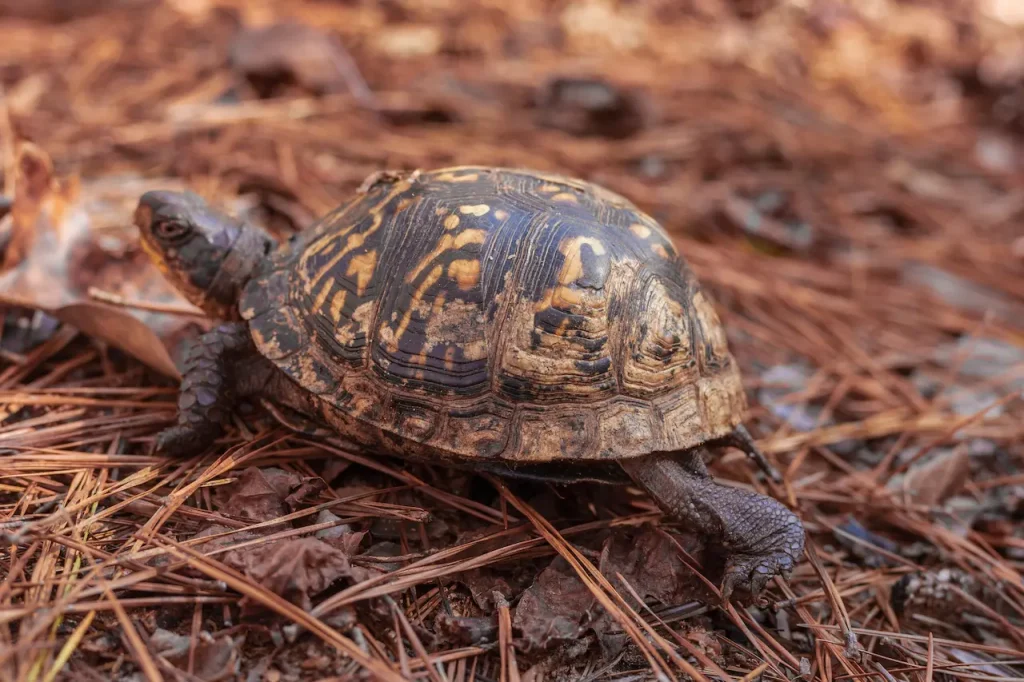
Common Box Turtles have a tall dome shape on the upper portion of their shell. They have a hinged shell as is common with box turtles. Their beak is down-turned. They can grow up to eight inches long. The shell of a common box turtle often has dark colors such as dark brown with spots of much brighter contrast, such as yellow or orange patterns.
Sexing a Common Box Turtle
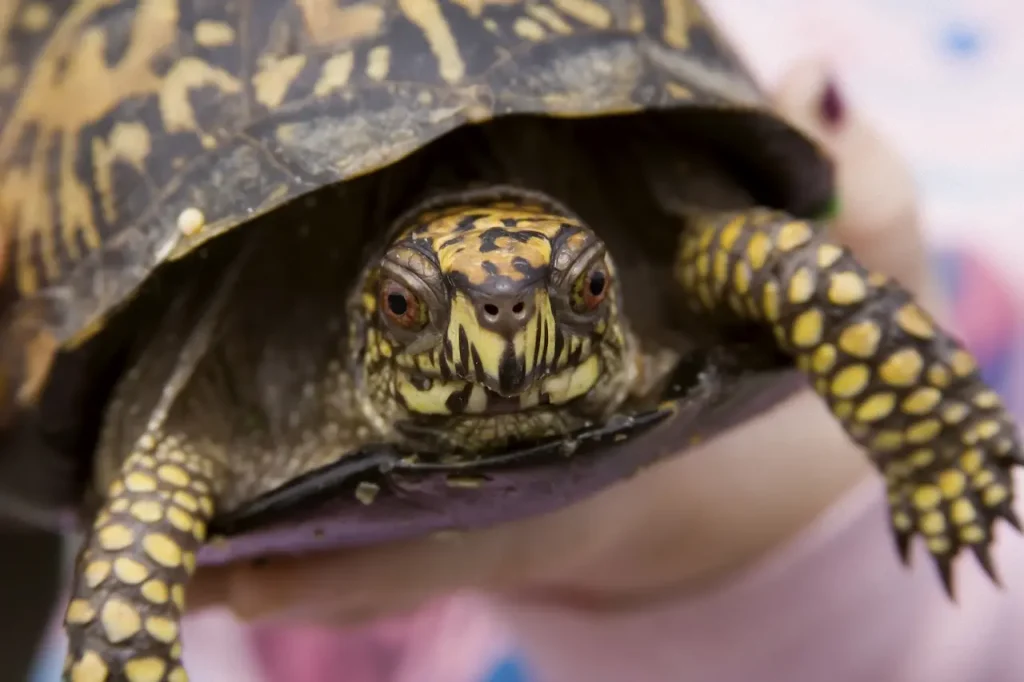
There are a few ways to sex a common box turtle. The easiest way is to look at their eyes. Males typically have red eyes, whereas a females eyes are usually brown or yellow.
The male also has a concave plastron whereas the females is flat.
What Doe a Common Box Turtle Eat?
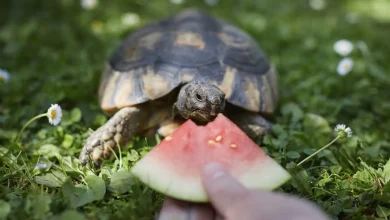
Common box turtles are omnivores, meaning their bodies can each both other creatures and plant matter. In the wild, their diets are extremely varied. Since they cover such large regions of eastern America, what they eat often depends simply on what is available in the area.
When they eat meat, they go for small insects such as beetles, slugs, earthworms, larva, grubs, and so forth. Their plant diet consists of things like berries, flowers, mushrooms, certain grasses, and fruit.
Be wary that common box turtles are likely to eat almost anything they come across if it smells edible, even if it is actually bad for them.
You can often find acceptable food for common box turtles at a pet store. Look for things like bags of turtle feed and feeder insects such as crickets or grubs.
How old can a Common Box Turtle get?
The Common box turtle can sometimes live all the way up to an impressive 100 years of age. It is believed that the odds of reaching this age are less likely when in captivity.
Keeping Common Box Turtles as Pets
The Common box turtle has been officially recognized as “vulnerable,” and there are now some limitations as to their capture and trade. The only state in which wild specimens can be captured for sale is South Carolina. However, while it is often illegal to capture a wild common box turtle for financial gain, the laws tend to be more relaxed about capturing them for personal ownership.
Common box turtles have many needs, and it is extremely important for pet owners to be aware of these needs. These turtles can die within a matter of days when put into captivity if their needs are not met.
Something to keep in mind is that the colorful shells of common box turtles tend to fade when they are kept in captivity. This occurs due to a lack of direct sunlight.
Housing a Common Box Turtle
To keep a common box turtle as a pet, you will need a fairly large enclosure. This should be tall enough that they cannot escape from it, and wide enough that there is ample room for all of their essentials. The enclosure should also be made from a material strong enough that the turtle cannot break out of it. A cardboard box should only ever be used as an enclosure for a very brief period of time, such as when cleaning their primary enclosure.
The turtle will need ample heat and lighting in a specific area of their living space. This way they can move closer to the heat source or further away from it as needed. A good level of humidity is required for their environment. Using a spray that has a mist function can help with this, by lightly misting fresh water around the turtle’s living space every so often. This must be done multiple times, daily. They also need a large source of water for drinking, soaking, and bathing.
Even though turtles can retreat into their shell, they still appreciate being able to hide within something else, such as a piece of log or bedding that they can burrow into.
Feeding a Common Box Turtle
It can be very difficult to ensure a captive box turtle gets all of the vitamins they need in their diet, so you may have to ask you veterinarian about supplements such as vitamin A and calcium.
Your turtle will want to be fed live insects that they can hunt. Most pet stores sell crickets, but you can feed them all sorts of things such as worms, grubs, cockroaches, and so forth. For greens, you can feed them romaine lettuce and dandelion greens (taken from a yard that does not use pesticides). They also enjoy fruits, berries, and mushrooms.
Different common box turtles can have different tastes, since they are native to such wide regions. You should offer your turtle a variety of foods and see what they like. Just make sure they are getting enough nutrients, so beware of them just eating one thing all the time.
Parasites
A common box turtle that was taken from the wild could have parasites. These can get under scales and shells, and might be hard to notice. If your turtle was taken from the wild, be sure to take them to the vet first thing, so they can be checked for parasites.
Also know that letting your turtle play outside, even under supervision, could result in the contraction of tiny unseen parasites. Because of this; it’s a good idea to have them checked by a vet periodically.
References
- IUCN Red List http://www.iucnredlist.org
- Congello, Karin. 1978. Nesting and egg laying behavior in Terrapene carolina. Proceedings of the Pennsylvania Academy of Science. 52(1): 51-56.
- Cook, Robert P. 2004. Dispersal, home range establishment, survival, and reproduction of translocated eastern box turtles, Terrapene c. carolina. Applied Herpetology. 1: 197-228.
- Dodd, C. Kenneth, Jr. 2001. Conservation Biology. In: North American box turtles: a natural history. Animal natural history series, vol. 6. Norman, OK: University of Oklahoma Press: 150-168.
- Dodd, C. Kenneth, Jr. 2001. Courtship and reproduction. In: North American box turtles: a natural history. Animal natural history series, vol. 6. Norman, OK: University of Oklahoma Press: 87-110.
- Dodd, C. Kenneth, Jr. 2001. Food and feeding behavior. In: North American box turtles: a natural history. Animal natural history series, vol. 6. Norman, OK: University of Oklahoma Press: 111-121.
- Dodd, C. Kenneth, Jr. 2001. Habitats and habitat requirements. In: North American box turtles: a natural history. Animal natural history series, vol. 6. Norman, OK: University of Oklahoma Press: 39-55.
- Dodd, C. Kenneth, Jr. 2001. Population structure and demography. In: North American box turtles: a natural history. Animal natural history series, vol. 6. Norman, OK: University of Oklahoma Press: 122-137.
- Dodd, C. Kenneth, Jr. 2001. Predators, parasites, and disease. In: North American box turtles: a natural history. Animal natural history series, vol. 6. Norman, OK: University of Oklahoma Press: 138-149.
- Ewing, H. E. 1933. Reproduction in the eastern box-turtle Terrapene carolina carolina (Linne). Copeia. 1933(2): 95-96.
- Allard, H. A. 1948. The eastern box-turtle and its behavior. Journal of the Tennessee Academy of Science. 23: 307-321